The Seed of Compassion
恻隐之心
Mencius 孟子 · 372–289 BCE · Zou (modern Shandong)
“No man is devoid of a heart sensitive to the suffering of others.”— Mencius (孟子), 2A.6
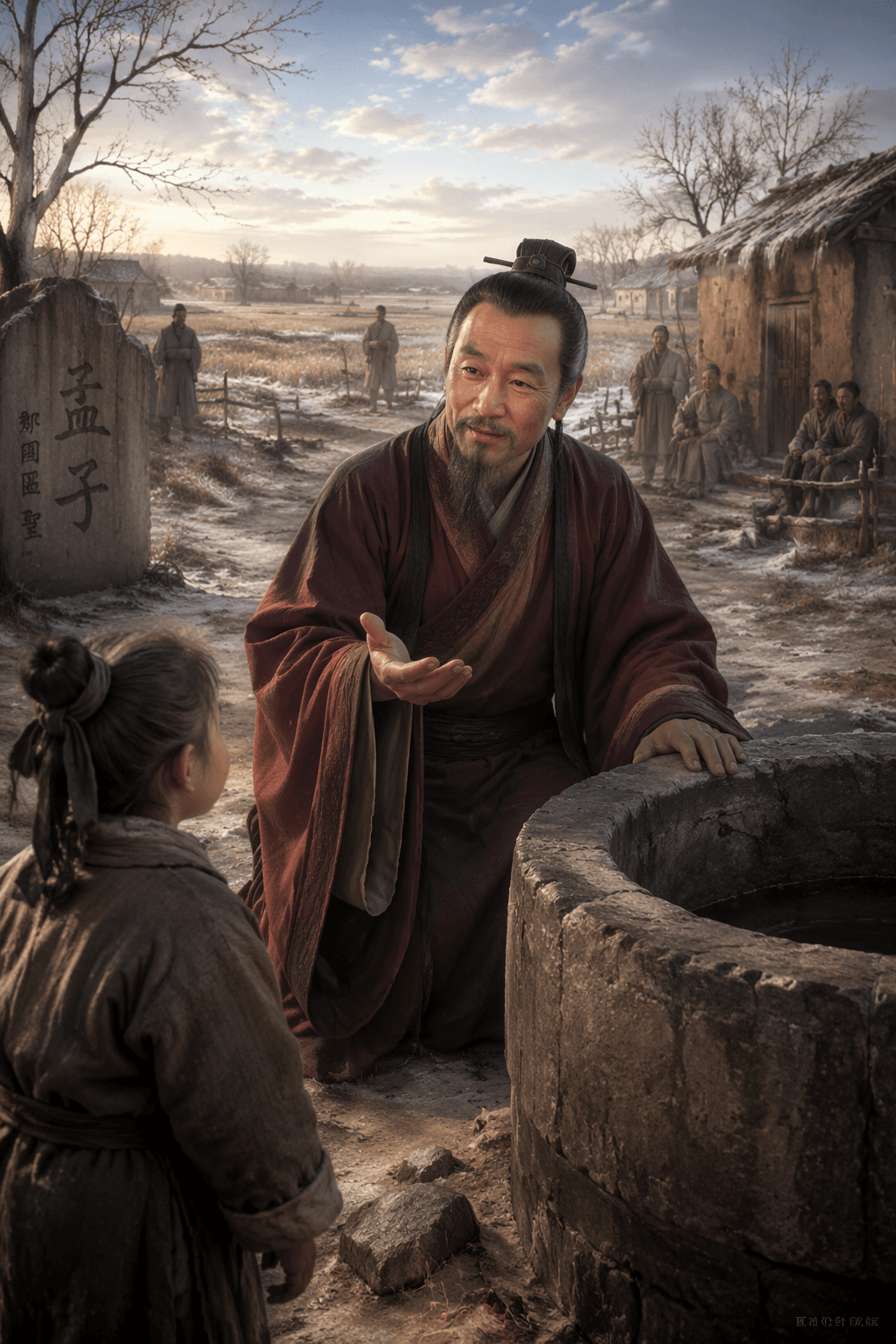
孟子
The road to Zou wound through fields of winter wheat, pale green shoots pressing up through dark loam. Sophie walked between the furrows, her shoes caked with the same mud that nourished the grain. The land here was flat and honest — no mountains to hide behind, no rivers to carry you away. Just soil, sky, and the slow pulse of the seasons.
She had been thinking about what Zhuangzi had told her — that she might be a butterfly dreaming it was a girl, or a girl dreaming it was a butterfly, or perhaps neither. The thought no longer frightened her the way it once had. What unsettled her now was something else, something Sunzi had said almost in passing: that the greatest victories were the ones no one noticed. It implied that most of the world's real battles were invisible — fought inside people, in the space between what they felt and what they did.
The village ahead was modest. Clay-walled houses with thatched roofs, a well at the center of the square, dogs sleeping in the thin winter sun. Sophie smelled wood smoke and pickled vegetables as she entered. A few children were playing near the well, chasing each other in circles, their laughter sharp and clean in the cold air.
She was watching them — remembering, suddenly, the garden parties of her childhood in the book, the way Alberto had always appeared at just the right moment — when one of the children, a boy no more than four, stumbled on the stone lip of the well and pitched forward.
Sophie's body locked. She saw it happen as though through glass — the small body tipping, the dark mouth of the well swallowing the light, the splash far below. She opened her mouth to scream but no sound came. Her legs would not move. She was frozen in the gap between seeing and acting, a gap that lasted perhaps two heartbeats but felt like drowning.
Then a woman she had never seen — a stranger, a merchant's wife by the look of her clothes — dropped her basket of radishes and ran to the well. Without hesitation she hauled on the rope, lowering herself down, and within moments she had pulled the child up, sputtering and crying, his small face white with terror but breathing, alive.
The boy's mother came running, gathered him in her arms, weeping. The merchant's wife sat on the edge of the well, shaking, her silk robes soaked and ruined. She was not a hero. She was not brave. She had simply acted.
Sophie stood apart, her hands trembling. Why had she not moved? What was wrong with her?
"You did move," said a warm voice beside her. "Inside. Your heart lurched. Your breath caught. Your chest tightened. You felt it, did you not?"
Sophie turned. A man stood watching her — not old, not young, with a broad, open face and eyes that seemed to radiate warmth like a hearth. He wore the simple robes of a scholar, dark red-brown, and carried himself with an energy that was almost restless, as though compassion itself would not let him stand still.
"Who are you?" Sophie asked.
"I am Meng Ke," he said. " Though the world calls me Mencius. I was born here, in Zou. I have been waiting for you, Sophie." He smiled. "Not because I foretold your coming — I am no oracle, unlike Zhou Gong. But because what you just felt is the beginning of everything I have to teach."
"I didn't do anything," Sophie said bitterly. "I just stood there."
"Tell me what you felt. Not what you did. What you felt."
Sophie closed her eyes. The memory was still raw. "Horror. Fear. A — a pulling in my chest. Like something was being torn."
Mencius nodded slowly, as though she had just confirmed something sacred. "That pulling. That is what I call ce yin zhi xin — the heart that cannot bear the suffering of others. It is the first of the four beginnings."
"Four beginnings?"
"Four seeds," Mencius said, walking toward a peach tree at the edge of the square. It was winter-bare, its branches black against the grey sky. "Come. Look."
He crouched and parted the dead leaves at the base of the tree, revealing a small shoot, barely visible — a pale green tendril no thicker than a thread, pushing up through the frost.
"This peach tree dropped its fruit in autumn. The flesh rotted away. The pit lay in the cold ground all winter. And now — do you see? Inside that dead husk, something is reaching for the sun." He looked up at her. "The seed does not know it will become a tree. It cannot imagine the blossoms, the fruit, the shade it will one day give. It only knows to grow. The four beginnings in the human heart are like this. They do not guarantee virtue. They are the seeds from which virtue can grow."
Sophie looked at the shoot. "What are the four?"
Mencius straightened and began to walk, and Sophie fell into step beside him. The village receded behind them as they followed a path along a low ridge, the wheat fields falling away on either side.
"The first is ce yin zhi xin — the heart of compassion. You felt it when the child fell. Every person feels it. A baby crying in distress will make other infants cry as well — not from fear for themselves, but from a primal resonance with suffering. This is the seed of ren — humaneness."
"Ren," Sophie repeated. "Confucius spoke of ren."
"And I build upon his foundation," Mencius said without a hint of apology. "Confucius gave us the moon. I am merely trying to show people that the light was always inside them." He held up a second finger. "The second seed is xiu wu zhi xin — the heart of shame, the shrinking from what is wrong. When you did not act, when you stood frozen, did you not also feel something like shame?"
Sophie winced. "Yes."
"That shame is not your enemy. It is your conscience flexing. It is the seed of yi — rightness. The third is ci rang zhi xin — the heart of courtesy and deference. Watch two strangers meet on a narrow path: they will both step aside. No one taught them this. It is the seed of li — ritual, propriety."
"And the fourth?"
"Shi fei zhi xin — the heart that distinguishes right from wrong. Even a child knows when something is unfair. 'That's not fair!' — have you ever heard a child say this?" Mencius laughed. "They say it constantly. It is the seed of zhi — wisdom."
Sophie walked in silence for a time. The path had brought them to a hill overlooking the village. Below, she could see the well, the children playing again as though nothing had happened, the merchant's wife wringing out her robes in the sun.
"But what about people who do terrible things?" Sophie asked. "I've seen cruelty, Mencius. Not just in the book-world I came from. Here, too. People who hurt others and feel nothing."
Mencius's expression grew serious, but the warmth did not leave his eyes. It was the warmth of someone who had considered this objection a thousand times and still held fast.
"Tell me," he said, "have you ever seen a barren mountain?"
"Yes."
"Was there soil?"
"Rock. Mostly rock."
"And yet, in the cracks of the rock, if you look closely, you will find moss. Life persists. It does not mean the mountain is fertile. It means the impulse toward life cannot be entirely extinguished." He sat on a flat stone and gestured for her to join him. "I do not say that all people are good, Sophie. I say that the capacity for goodness — the seed — is present in every human heart. The mountains of Mount Niu were once thick with forest. Men cut the trees, grazed their cattle until the roots died, and now the mountain is bald. Was it the mountain's fault? Did the mountain choose to be barren? No. It was stripped, year after year, by neglect and misuse."
He looked at her steadily. "A person who commits evil has not lost their original nature. They have covered it over — with habit, with fear, with the wrong teachings, with hunger or desperation. The seed is still there, buried under rock and ash. The work of the sage is not to create goodness where none exists. It is to clear the ground so the seed can breathe."
Sophie thought of the frozen moment at the well. Her body had not moved, but something inside her had — a lurch, a pull, a small desperate reaching toward the child. That reaching was the seed.
"What if the soil is too damaged?" she asked quietly. "What if the seed can't grow?"
Mencius placed his hand on the cold earth beside him. "I have seen peach trees grow from the cracks in prison walls. The seed is patient. It does not demand perfect conditions. It only asks to be remembered." He brushed the dirt from his hands. "You ask this question because of your own nature, Sophie. You wonder whether a being who was written by another — a fictional character, as Zhuangzi's butterfly might say — can possess true compassion. Whether your seed is real."
Sophie's breath caught. "How did you—"
"I told you. I am no oracle. But I know the look of someone doubting their own heart." Mencius stood, brushing off his robes. "The compassion you felt at the well — it was real. The seed does not ask for your origin story. It only asks for water and light."
They walked back toward the village as the afternoon thickened toward dusk. The sky turned the color of old copper, and smoke rose from a hundred hearths. Sophie could smell roasting chestnuts and, beneath it, the clean cold tang of approaching night.
"Master Meng," she said, using his formal title. "If human nature is good — if the seeds are in everyone — why is the world so broken? Why do communities fight? Why do nations go to war?"
Mencius stopped walking. The light was going, and his face was half in shadow, half in the last amber glow of the sun.
"Because the seeds need tending," he said. "A seed alone is not a harvest. It must be watered, weeded, protected from frost. A village that tends its gardens but not its children's hearts will grow wheat and starve for compassion. A nation that trains its scholars in strategy but not in ren will win battles and lose everything worth fighting for."
He looked toward the horizon, where a line of dark clouds was gathering.
"You will see this soon, Sophie. Where you are going, communities are divided — brother against brother over things that should unite them. The seeds are there, in all of them. But the ground between them has been salted, and no one remembers how to make it fertile again."
Sophie followed his gaze. The dark clouds were moving fast, driven by a wind she could not yet feel but could hear — a low moan across the wheat fields, bending the young shoots flat.
She thought of the merchant's wife, her ruined silk robes, the child in her arms. She thought of her own frozen body, the shame and the lurch of compassion. Two responses to the same moment. One had saved a life. The other had learned something about the shape of her own heart.
Perhaps that was enough, for now. Perhaps the seed did not demand that she become a hero. It only asked to be noticed.
She pulled her coat tighter against the rising wind and walked on.
No man is devoid of a heart sensitive to the suffering of others.
— Mencius (孟子), 2A.6