The Weight of Ritual
礼仪之重
Confucius 孔子 · 551–479 BCE · Lu (modern Shandong)
“Is it not a pleasure to learn and to repeat or practice from time to time?”— Analects (论语), 1.1
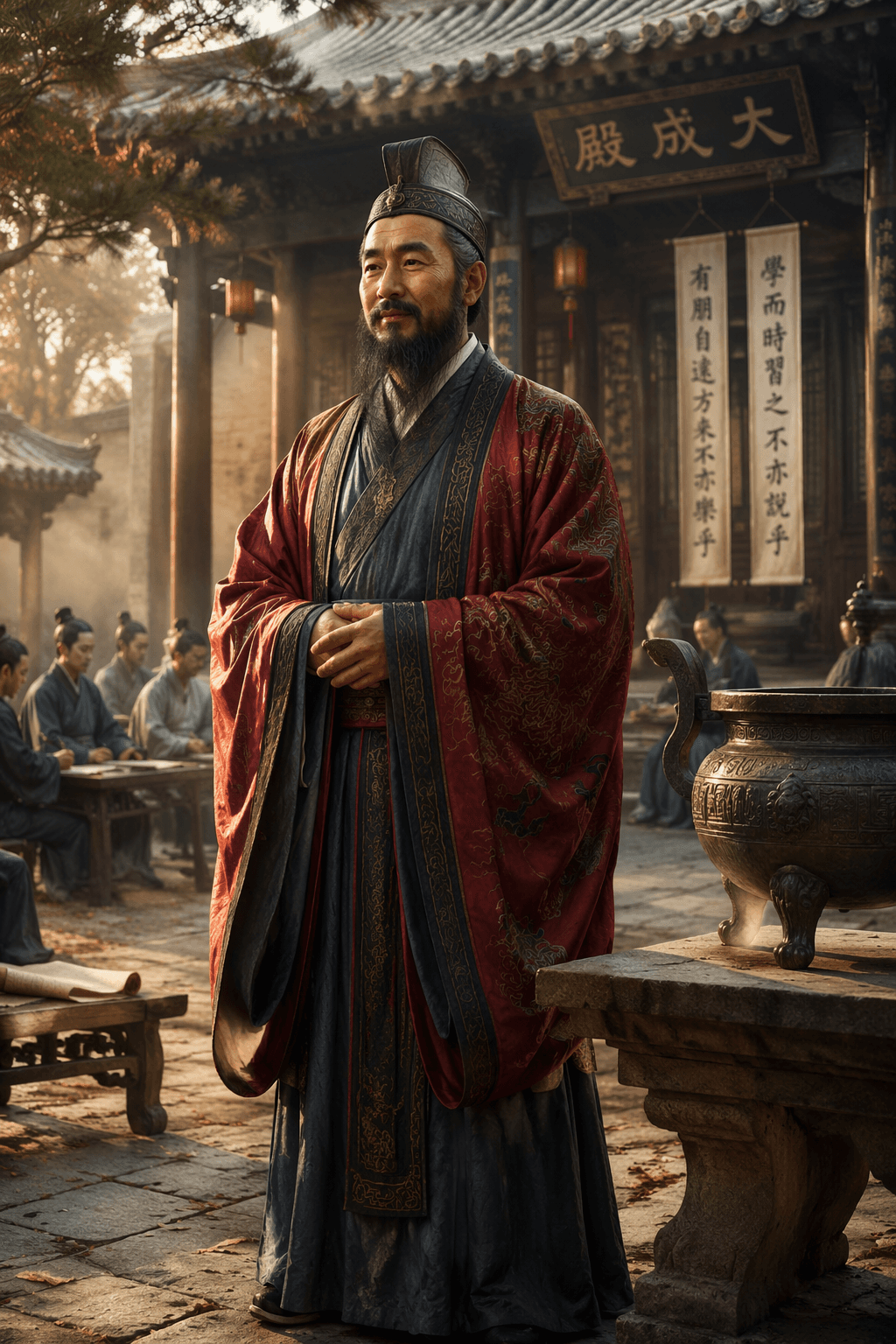
孔子
I
The city was called Qufu, though Sophie did not learn its name until much later. What she learned first, and with painful immediacy, was that she did not belong in it.
She entered through the eastern gate at midmorning, when the streets were full of people and purpose. The city was dense with life in a way she had never encountered — not in Oslo, not in the pages of the book, not anywhere. Merchants shouted from wooden stalls draped with bolted silk and cured meat. Children darted between the legs of ox-drawn carts. Old women sat on low stools, husking grain and talking in a musical language that washed over Sophie like weather — present, pervasive, and entirely opaque.
She was hungry. She had not eaten since before the crossroads, and the smell of food — fried dough, roasted chestnuts, something savory and unfamiliar simmering in an iron pot — made her dizzy with want. She approached a stall where a woman sold flatbreads from a clay oven and held out a copper coin she had found in her pocket, not knowing if it was the right currency or even if it came from this world.
The woman looked at the coin. Then she looked at Sophie — at her foreign clothes, her uncovered hair, her posture, which was all wrong. Sophie had walked up to the stall directly, without hesitation, the way a person in Norway would approach a bakery counter. But here, it seemed, even buying bread involved a choreography she did not know.
The woman said something sharp. Other people turned. A man nearby made a disapproving sound. Sophie felt the heat rise to her face — the particular humiliation of being wrong without understanding what you were wrong about.
She backed away. She tried another stall, and another, and each time the result was the same: a wall of incomprehension, not merely linguistic but social, as though she were violating some invisible architecture with every gesture she made.
By the time she retreated to the stone steps of what appeared to be a temple, she was close to tears. Not from hunger, though she was hungry. Not from rejection, though she had been rejected. From the crushing awareness that she was, in some fundamental way, shapeless — a person without the rituals and relations that gave other people their place in the world.
II
"You sit like a foreigner," said a calm voice above her.
Sophie looked up. A man stood at the top of the steps. He was of middle years, perhaps fifty, with a neatly trimmed beard and robes of unostentatious quality — not a merchant, not a laborer, but someone whose bearing carried a quiet authority. Behind him, through the open doors of the temple, Sophie could see young men seated in rows, copying characters onto bamboo slips with focused attention.
"I am a foreigner," Sophie said.
The man descended the steps and sat beside her. He did this with a precision that struck her even through her misery — the way he adjusted his robes before sitting, the particular distance he maintained from her body, the angle of his back. Everything about him was deliberate, considered, as though even the act of sitting on stone steps were a kind of statement.
"My name is Kong Qiu," he said. "Though my students call me Kongzi — Master Kong. Some call me other things as well." He smiled, a precise and careful smile. "You may call me whatever allows you to speak."
"Sophie."
"Sophie." He tested the name, as though tasting it. "You have come from far away."
"Very far."
"And you have found that the people here do not receive you as you expected."
Sophie let out a breath. "I tried to buy bread and somehow made everyone angry. I don't understand. I wasn't rude. I didn't push or steal or —"
"You approached the vendor directly," Kongzi said. "Without greeting her first. You did not bow. You held the coin in your left hand, which is the hand associated with impurity. And you stood too close."
Sophie stared at him. "How do you know all that?"
"Because I was watching. Not you specifically — I watch everyone. The way people move through the world tells me everything about what they understand and what they have yet to learn." He paused. "You understand nothing of li."
"Li?"
"Ritual. Propriety. The thousand small ceremonies that hold human society together." He gestured at the bustling street below them. "Every person down there is engaged in li. The way the merchant addresses his customer. The way a son bows to his father. The way the old women sit together to husk grain — there is a right way to do even that. Not because heaven decreed it, but because without these patterns, we are merely bodies occupying the same space."
Sophie frowned. "That sounds like... rules for the sake of rules. Empty formality."
Kongzi regarded her with a patience that was not condescending but genuinely interested, as though she had said something worth considering carefully.
"In the West — in the world you come from — you value the individual above the relation, yes? The free self, unbound by convention?" He did not wait for her to answer. "Here, we believe that the self is not an island. It is a note in a melody. Without the other notes, without the rhythm and the key, the note is merely a sound. Li is the music that lets each note be heard."
III
He brought her into the temple. The students looked up with curiosity but did not interrupt their work, and Sophie understood that this too was li — the particular way a student receives a visitor in the presence of a teacher.
Kongzi gave her bread and water. She ate, and he watched her eat, and she was suddenly conscious of her chewing, her posture, the speed at which she consumed the food. She slowed down.
"Good," he said. "You are learning already."
"Learning to eat?"
"Learning to be aware. Li begins with awareness — of your own body, of the people around you, of the invisible threads that connect you to them. Most people move through the world asleep. They speak without hearing. They act without seeing. They eat without tasting. Li is the practice of waking up."
He sat across from her, and for the next hour, he explained. Not in the sweeping, abstract way that Alberto had explained Western philosophy in his letters, but in specifics — concrete, grounded, almost mundane.
Ritual is not about gods, he said. It is about people. When a son bows to his father, he is not worshiping the father. He is acknowledging the relationship that makes both of them who they are. The father, in receiving the bow, acknowledges his responsibility to the son. The bow is not empty. It is the visible shape of an invisible bond.
The same with the vendor, he continued. When you greet her before asking for bread, you are not being polite. You are recognizing her as a person, not a bread-dispensing machine. The greeting creates a relationship — however brief — between two human beings. Without it, you are not buying bread. You are taking it.
Sophie thought about the Norwegian supermarkets she remembered from the book — the efficient, anonymous transactions. The self-checkout machines. The elaborate choreography of not making eye contact. Was that freedom? Or was it a different kind of ritual, one that enshrined distance instead of connection?
"Tell me about ren," she said. She had heard the word somewhere — perhaps from Zhou Gong, perhaps from the wind.
Kongzi's face changed. A softness entered it, as though she had asked about a person he loved.
"Ren is the hardest word in our language to translate. Some say 'benevolence.' Some say 'humaneness.' I say it is the feeling you have when you look at another person and understand that their joy and suffering are not separate from your own." He leaned forward. "Li without ren is empty ritual — exactly the criticism you raised a moment ago, and a fair one. But ren without li is formless goodwill that cannot find its way into the world. They need each other. Li is the vessel. Ren is the wine."
IV
The afternoon light slanted through the temple doors. The students had finished their copying and were now engaged in a discussion that Kongzi occasionally joined, rising from his seat beside Sophie to offer a correction or a question, then returning to her with the same careful attentiveness.
Sophie asked him about the book. About Alberto. About the whole strange architecture of her previous existence — a philosopher who taught through letters, a girl who learned by reading, a world that existed only because an author had willed it.
Kongzi listened. When she finished, he was quiet for a time.
"Your teacher wrote you letters," he said. "My teacher was the past. I study the rites of the ancient kings, the songs of the old poets, the histories of dynasties that rose and fell. I do not invent. I receive. And in receiving, I try to understand what in the past is worth carrying forward."
"But how do you know what's worth keeping and what's just... habit?"
"By testing it against ren. Does this practice increase human dignity? Does it deepen the bonds between people? Does it help a person become more fully human? If yes, it is li. If no, it is merely custom, and custom without conscience is a dead thing."
He stood. The sun was setting, and through the temple doors, Sophie could see the city of Qufu transforming in the golden light — the same streets that had rejected her, now softened and strange, like a face seen by candlelight.
"You will stay the night," Kongzi said. It was not a question, but it was not a command either. It was an offer shaped as a certainty, and Sophie recognized this as li too — the art of making someone welcome without making them feel obligated.
"Thank you," she said.
"One more thing." He paused at the door. "You asked me earlier whether ritual was empty formality. I gave you an answer. But the real answer is this: li is a practice, not a belief. You cannot understand it by thinking about it. You can only understand it by doing it. Tomorrow, you will try again to buy bread. And this time, you will greet the woman first."
Sophie nodded. And in the nodding, she felt something she had not felt since leaving the book — a sense of place, however small and provisional. She was not free in the way she had imagined freedom to be — solitary, unconstrained, a self without context. She was becoming free in a different way: embedded in a world of relations, learning the music of a civilization that had been playing for three thousand years.
But that night, as she lay on a mat in the temple's guest room, listening to the last sounds of the city settling into sleep, she heard something else — a sharp, raised voice outside the wall, followed by another, followed by the clatter of something falling. Two men, arguing in the street, their words incomprehensible but their anger as clear as mathematics.
Conflict. It was everywhere, even here. Even in this city of ritual and propriety, people fought.
Sophie pulled the thin blanket closer and thought about what it meant to live among others — truly among them, entangled in their needs and greeds and grievances. She had learned the shape of courtesy. But courtesy, she suspected, was only the beginning. What happened when the music broke down? When the rituals failed? When two people stood face to face and neither could bow?
The argument outside grew louder. Then, suddenly, it stopped. Sophie heard footsteps — one set walking away, the other standing still. The silence that followed was heavier than the shouting had been.
She did not sleep for a long time.
Is it not a pleasure to learn and to repeat or practice from time to time?
— Analects (论语), 1.1